
RIM’s big differentiator: staying out of China
Posted: July 13, 2012 Filed under: Uncategorized | Tags: BT, china, cyber security, hacking, IP, IP theft, RIM, Verizon business Leave a comment In a startlingly refreshing display of honesty, RIM CEO Thorsten Heins has come out and said the firm is steering clear of China when it comes to manufacturing to reduce the risk of IP theft which could cripple its business.
It’s a bold statement, given that in my experience most tech firms – and even analysts – are very reluctant to discuss China in anything approaching critical terms, especially when cyber security is mentioned.
It’s certainly a valid point. I’ve reported in the past for The Register how many multinationals are suffering IP loss from their Chinese business units.
As RIM is teetering on the brink financially and seems only to be able to differentiate competitively from its rivals by virtue of the superior security capabilities of its handsets and infrastructure, any breach would be a huge blow.
That’s not to say it is necessarily safer anywhere else, but eliminating China from the supply chain could be a wise move.
Even the Chinese government has indirectly admitted its firms do not innovate enough themselves – the inference I’m drawing here is they nick a lot of IP instead.
Kenny Lee, a forensics expert with Verizon Business, sat down with me on Thursday to explain what hacking activity he’s seeing inside Hong Kong and Chinese firms.
Interestingly, while he did admit there was a fair amount of “low level” IP theft from firms in the region, mainly due to employees looking to set up their own businesses, there is a more insidious data leakage problem – technology transfers.
These agreements are usually foisted on foreign multinationals wanting to expand into China. The deal is that they have to partner up with a local Chinese firm by law to sell into the country’s huge market, and in doing so will usually need to share IP with them.
After a certain point, Lee explained, the Chinese partner usually has enough knowledge to pull out of the venture, having sucked all the IP it needs from its foreign partner.
There’s the rub for foreign firms such as BT, who can’t gain direct access to the market but equally reject the idea of handing over their hard-earned IP.
There’s no chance of things changing from the top anytime soon, so foreign firms will continue to have to weigh the risks and make that judgement.
Don’t panic Samsung – China’s tech spending is not slowing
Posted: May 24, 2012 Filed under: china, IT spending, technology | Tags: china, consumer, samsung, spending, tech Leave a comment I covered a story this week detailing comments Samsung China’s CEO Kim Young-ha apparently made to the FT, which basically summarised are – China’s austerity measures are dampening down consumer spend and this is BAD news for IT suppliers everywhere.
Now, I’m not suggesting Mr Kim doesn’t have his finger on the pulse over in that there China.
After all, Samsung has such a broad portfolio of electronics items covering virtually every conceivable category, from NAND chips to tablets, that the company should be a good canary down the mine when it comes to taking the pulse of the IT market in China, if you’ll excuse the mixed metaphor.
However, the piece overwhelmingly came across to me as fear-mongering. Kim told the paper that the Chinese government’s austerity measures targeted at the housing market had gone a bit over board and were having an impact on consumer spending.
Yet there is no evidence for this, aside from a brief reference to the fact that TV sales were disappointing in the recent Golden Week holiday period, and an unsubstantiated prediction from Kim that the domestic tech market would likely grow by just seven per cent in 2012.
I’m not sure whether this can quite be viewed as incontrovertible evidence that there is a decline, but even if spending were to slow down slightly, it’s still way above that of the West and probably had to slow down at some point.
The other benefit IT manufacturers have when it comes to the Chinese economy is that government feels much less beholden to international markets – within reason – and much more capable of acting swiftly and decisively to address any economic instability; whether this means slowing down one part of the economy or injecting a bit of stimulus in another part.
To top it all off, the signs from the analyst houses are all pretty rosy when it comes to IT sector growth in China. IDC predicts a surge in consumer tech spending of nearly 30 per cent while IHS iSuppli says PC sales there will grow 13 per cent this year.
The times they are a-booming in the PRC, despite what Samsung says.
Patriot games as hackers exchange fire over disputed islands
Posted: April 27, 2012 Filed under: Uncategorized | Tags: china, cyber crime, hacking, hacktivist, Panatag Shoal, philippines Leave a comment This week we saw more news emerge of the escalating tit-for-tat cyber attacks apparently being launched by actors sympathetic to the Philippines and China over a naval stand-off in the South China Sea.
Scarborough Shoal – also known as Panatag Shoal or Huangyan island – is the region long-disputed by the two countries and things got serious earlier this month after Filipino navy officials tried to arrest Chinese fisherman operating in the area but were stopped by Chinese surveillance boats.
Cue a barrage of cyber attacks on Philippine government and university web sites by apparent Chinese hackers, and then reprisals from the other side.
It’s pretty basic stuff, site defacement and DDoS attacks designed to send a clear message to the other side, and in this kind of thing China is probably a world leader.
Although it will never be revealed exactly how many patriotic hacktivists there are in the People’s Republic, what’s more interesting is their relationship with the government. In all but the most repressive states – think Iran or Syria – governments disassociate themselves from any hacking behaviour, but I learnt recently that China has done the opposite.
It has long been suspected, but China has effectively made a deal with the hacking community, a source told me, which goes thus:
- Never hack your own government or companies in your own country
- If you find anything of interest in your hacking activities which could help your country improve its status on the world stage, hand it over.
- When called upon to help the ‘cyber military’, make sure you respond
The deal is simple, the source explained, follow these rules and you can hack away with impunity. It means attacks of the sort seen this month on the Philippines can be carried out with the covert blessing of the government and the Party.
Of course the PRC’s standard response to these accusations is that it denounces all hacking activities, that it is taking steps to prevent cyber crime and that China itself is as much a victim of such attacks as western countries.
Even if tracking technologies mature to the level where the source of such attacks can be pinpointed, by operating at arm’s length, the government will always have the advantage of plausible deniability. It’s just a case of whether the international community will eventually lose patience with China and demand action, economic superpower or not.
Jury’s out on Apple and Foxconn deal with FLA
Posted: March 30, 2012 Filed under: Uncategorized | Tags: apple, china, fla, foxconn, ipad, iphone, wage Leave a comment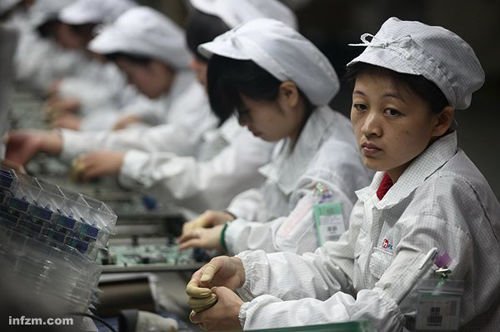
(source: infzm.com)
Have just finished a news story for The Register on what Reuters is calling a ‘landmark deal’ between Foxconn, Apple and the non-proft Fair Labor Association over pay and working conditions at Foxconn plants.
Now we can all talk ad nauseum about whether Apple is being unfairly singled out here and whether the workers even want or deserve to be treated differently than the vast majority making our clothes, shoes and shiny toys.
But here are the facts.
People committed suicide at these factories, quite a lot in fact, and I don’t buy the fact they were all depressed country bumpkins out of their depth in a new environment – there must be something seriously wrong inside those plants to lead to that.
So a couple of points to note from this. I was quite impressed the FLA produced such a damning report of conditions – many groups expected them to either go easy on App-conn or for the factory owners to have improved conditions to such a degree for their planned inspection that they got a rose tinted view.
This didn’t happen.
So as a result of the guarantees Foxconn and Apple have given, overtime and working hours will come down to within legal limits, accidents will be more accurately recorded, internships adapted, and union elections will not be interfered with by management.
All of which is great, but I’m going to remain sceptical until July 2013, when the deadline for changes comes (why so far away, by the way?!).
For one, the report doesn’t mention the management abuses of staff – either mental or physical – which some argue contributed to those suicides, and the it also glosses over the widespread abuses of the internship scheme as uncovered by SACOM.
There are other guarantees given by Foxconn which will be very hard to substantiate – whether union representatives are elected freely, accidents are recorded properly and overtime compensation doled out appropriately, to name but a few examples.
The proof for this will certainly be in the pudding, and as I’ve said before, the key to it all is consumer pressure – that drifts away and things could very easily slip back into old patterns.
 phil muncaster