
Rackspace goes East with first Asian public cloud launch
Posted: October 22, 2013 Filed under: Uncategorized | Tags: ajit melarkode, apac, BPO, cloud computing, hong kong, hybrid cloud, iaas, open source, openstack, private cloud, public cloud, rackspace hosting Leave a comment OpenStack cloud vendor and Amazon–agitator Rackspace Hosting is launching its first public cloud offering for Asia in Hong Kong today, so I caught up with APAC MD Ajit Melarkode to talk all things Hong Kong, cloud and Rackspace.
I covered the news over at The Reg. Given that not many businesses rely solely on the public cloud, the announcement can be seen more in context of Rackspace’s Hybrid Cloud offering – which allows users to mix and match between public and private cloud and dedicated server hosting.
As such, I’m sure IT managers in the region will be keen to have another option for their cloudy needs.
They should also be assured that Rackspace is certainly investing significantly in the region, and Hong Kong, Melarkode told me. “We’ve sent a lot of Rackers out to set up here,” he said. “We’re not treating it as a satellite office – Hong Kong has really come into its own this year.”
Testament to this is Melarkode himself, who has experience of running operations on the ground in the region, and the fact that the firm is setting up dedicated finance, HR and marketing departments, as well as hiring a regional CTO, lead engineers, SMB and enterprise support staff, and ensuring that there is a good spread of local language speakers.
So who is Rackspace hoping to target with its new offering? Well, according to Melarkode, the growth of the Hong Kong office and APAC hub can be seen in parallel with the expansion of Rackspace customers into Asia: “as our customers expand we expand with them – we’re driven in a major part by client requirements”.
Another market he mentioned was that of the smaller innovative local companies in industries like retail and technology which are unencumbered by legacy infrastructure and are “leapfrogging onto new technologies like mobile and cloud”.
Melarkode was unsurprisingly quick to leap to the defence of Asian firms, which are often branded as copy cats and accused of lacking the ability to truly innovate.
He argued that creating services on top of “building blocks” already developed in the West does not necessarily amount to copying – and pointed out that firms from the region are contributing code to OpenStack, which he claimed is certainly not the behaviour of a technology laggard.
The region in general, while perhaps slightly behind the West, is certainly catching up in terms of the maturity of its IT services industry.
“I’ve seen how the region has developed right from the time Indian outsourcing started blooming in 1993, to the more hardware and infrastructure focus in China and the BPO success taking hold in the Philippines,” he explained.
“What I see is lagging behind here but the pace is still fantastic. Look at how it’s catching up. Lots of clients used cloud just for back-up and storage but now they’re starting to use it for app testing and development. The catch-up rate is astonishing.”
Rackspace will certainly need that maturity to expand beyond the handful of early movers in APAC if it’s to recoup some of its growing investment here.
Things are moving pretty fast, though, with the firm doubling headcount and its datacentre space in Hong Kong to meet expected demand and with plans to do so again in the coming year, Melarkode said.
China ready to lift the Great Firewall. Maybe. In part of Shanghai
Posted: September 24, 2013 Filed under: Uncategorized | Tags: censorship, china, facebook, great firewall, hong kong, li keqiang, shanghai, shanghai free trade zone, twitter Leave a comment Reports emerged from China today that at first sight seem almost unbelievable: the Communist Party about to lift the Great Firewall and unblock access to Facebook, Twitter and a host of other banned sites.
Then the small print. If the anonymous government sources are speaking the truth, it will be only be relevant to Shanghai Free Trade Zone, a 28 sq km pilot project designed to encourage greater foreign investment in China and open its economy up to the international markets.
“In order to welcome foreign companies to invest and to let foreigners live and work happily in the free-trade zone, we must think about how we can make them feel like at home,” one government source told the South China Morning Post.
“If they can’t get onto Facebook or read The New York Times, they may naturally wonder how special the free-trade zone is compared with the rest of China.”
Now while that seems fair enough, the Communist Party isn’t known for its love of unfettered access to the internet – after all the free flow of information online is precisely the sort of thing which it knows will lead to its demise.
So what’s this all about? Well, a few things sprung to mind:
- China is in the middle of one of the worst crack downs on online freedom anyone can remember, so don’t expect this localised liberalisation to spread anywhere else in the Middle Kingdom. The party is very much still for the suppression of any discussion it deems “harmful”.
- Even if the Great Firewall is lifted in the Shanghai zone, doing so from a technical standpoint will take time, according to Forrester analyst Bryan Wang.
“The network within the free trade zone will exist something like an intranet, which is connected to the international backbone without going through the Great Wall firewall,” he told me. “Current infrastructure will not be enough to support the future development. China Telecom or Unicom will need to lay out new fibre in the free trade zone.”
- The Party giveth and it taketh away. Nothing is confirmed yet, and until state-run media reprint the story, we can probably take it as just a rumour, possibly one designed to increase international publicity for the zone, which is a pet project of new premier Li Keqiang.
The whole free trade zone itself is only a pilot, so we can expect Beijing to bring the Great Firewall crashing back down on the region if its censorship-free internet policy backfires.
On a side note, how will Hong Kong react to the free trade zone?
If the Shanghai pilot is successful, more of them could spring up across China, effectively stealing its thunder as the only truly outward facing, economically liberalised, online censorship-free region in the Middle Kingdom.
Although a free and unfettered internet may soon no longer be a differentiator for Honkers, however, it’s likely that its superior IP protection regime, rule of law and business friendly visa system will still tip the balance in its favour for most MNCs.
Data security incidents hit 47,000 in 2012
Posted: May 8, 2013 Filed under: Uncategorized | Tags: apac, APTs, china, CISO, cloud computing, cyber crime, data breach investigations report, DBIR, due dilligence, hong kong, informato, state sponsored espionage, targeted attacks, verizon Leave a commentLast week I popped over to the Quarry Bay HQ of Verizon Business in Hong Kong to hear more about the annual Data Breach Investigations Report.
The report’s really come on since I covered it way back in 2008, and this year pulled data from an unprecedented 19 reputable sources including Scotland Yard, the US Department of Homeland Security and many more.
The Register covered the main news from the report when it was launched the week before – that China was responsible for a whopping 96 per cent of state-affiliated attacks – so I was keen to get some other APAC-relevant insight from the team.
Unfortunately there wasn’t much to be had, in fact the report itself only mentions Asia Pacific once as a break-out region, to illustrate the top 20 threat types across the whopping 47,000 security “incidents” recorded over 2012.
What this probably tells us is that methods of collecting the data at the moment are pretty non-standardised across the globe, which makes drawing any clear comparisons difficult between regions.
Another thought that occurred: it’s fairly obvious that organisations across the globe suffer from the same kinds of information security risk – whether hacktivist, financially motivated criminal or state sponsored espionage-related.
As Verizon’s HK VP Francis Yip said: “No one is immune from cyber crime. As long as you have an IP address, you are a target, no matter how long you spend online.”
In this respect, there were no startling new trends as such to pull out of the report, aside from China’s consistent and persistent appearance as number one source of state-sponsored shenanigans.
This is probably good news for under fire CISOs, now tasked not only with deflecting financially motivated cyber crime and attempts from hacktivists to take down their sites and steal credentials, but also under-the-radar information theft from APT-style attacks.
What’s also good news, is Verizon’s assertion that the cloud is no less safe than any other form of computing system, as long as IT teams make sure they carry out due diligence on providers.
“Cloud can actually be more secure, because these providers are doing it on an industrial scale with staff who know what they are doing,” argued Verizon’s APAC head of identity and privacy services, Ian Christofis.
While all this is certainly true I definitely got the impression from the briefing that many firms are still failing on the security basics.
“Could try harder” is probably a suitable report card take-away for businesses from 2012.
Hi-tech horse racing wizardry down at Happy Valley
Posted: April 5, 2013 Filed under: Uncategorized | Tags: agile, betting, gambling, happy valley, hong kong, hong kong jockey club, horse racing, IBU, soa, touchscreen, waterfall Leave a comment I was at Hong Kong’s world famous Happy Valley racecourse the other week to get the low-down on the IT set up there.
IT leaders at the Hong Kong Jockey Club are frequent participants in local technology-related events and with good reason.
The unique pressures of not only running an organisation with over 20,000 employees but also an infrastructure which needs to support the storage, management and delivery of vast quantities of real-time racing data, as well as secure betting transactions, must be enough to keep anyone awake at night.
HKJC apparently has to deal with something like six million bets on a typical race day, so the system needs to be able to hold its own.
I was shown around the non-profit’s latest project – the IBU (Interactive Best for You) table – by director of programme management, Scarlette Leung.
She explained that the table was designed from scratch in a process starting back in 2009.
The fully touchscreen affair is designed to attract a younger, professional group to the sport – people who aren’t familiar with form and just want to have a fun night out, with a bit of betting in between food and drinks.
Although pretty much a novice at this sort of thing, it didn’t take me long to get used to the drag and drop interface, which displayed info by four easy to understand parameters – ability, jockey and trainer, fitness and draw. Payment is via a PIN-locked smart card, which makes it even more user-friendly, and even I managed to win a few dollars.
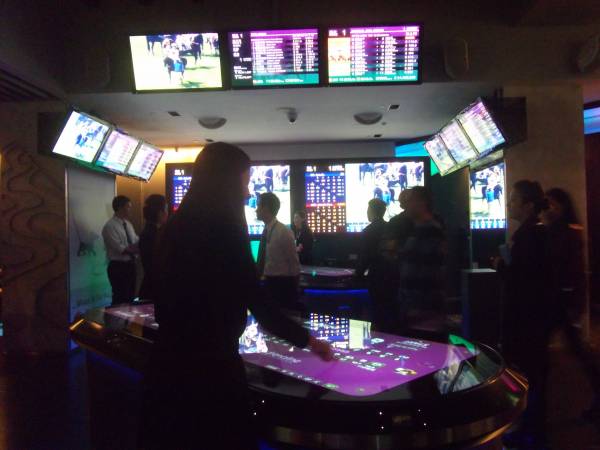
More interesting to me was the infrastructure behind it. Leung explained that the most challenging bit of the project was integrating the front end IBU and video displays with back-end infrastructure including smart card account management, odds and racing stats, security etc. The whole project was pushed through using Agile and Waterfall methodologies with a US manufacturer responsible for building the IBUs.
Leung was coy on future plans for the Club, but I could imagine seeing a few more of these tables on the way, and for the smart card system to be made more ubiquitous for payments at the ground and Sha Tin.
Given the SOA is reusable, the same simplified IBU betting experience could also potentially be pushed out in a mobile app form.
Either way, Happy Valley is world’s away from the kind of horse racing experience most UK betting fans are likely to see – but whether this kind of hi-tech whizz bangery will catch on in Blighty remains to be seen.
ZTE in 2013: do smartphone designers dream of electric sheep?
Posted: February 1, 2013 Filed under: Uncategorized | Tags: blade runner, CES, china, Chinese new year, FBI, Grand S, hagen Fendler, HD, hong kong, huawei, Iran, shenzhen, smartphone, telecoms equipment, zte, ZTE Grand Memo Leave a comment I popped down to ZTE’s pre-Chinese New Year lunch for journos in Hong Kong earlier this week to see what the world’s fifth largest smartphone maker had to say for itself.
It’s not been an easy year for it or Shenzhen rival Huawei, who were both named as a national security risk in a US congressional committee report released at the tail end of 2012 in the bi-partisan hubbub typical of pre-election months.
In addition, ZTE has been under lengthy investigation by the FBI on suspicion of selling embargoed US-made tech to Iran and then covering it up when found out. Then there were the false rumours of swingeing job cuts at the firm and a $5bn cash injection from the Chinese government.
Despite its problems, however, ZTE remains on the move in the smartphone space, an innovator in telecoms infrastructure with its LTE offerings and has plans to grow the enterprise business despite the kind of government roadblocks put up in Australia, the US and now India.
Head of handset strategy Lv Qian Hao battled manfully with the flu to show me the firm’s latest high-end handset, the 5.7in Grand Memo (no pics I’m afraid). It comes across as a smallish version of Huawei’s massive six-incher the Ascend Mate and probably benefits from not being quite as large – in other words I could just about use it as a phone without looking daft.
In the rapidly developing smartphone space, specs like 13 megapixel camera, quad core 1.7Ghz Snapdragon processor and a 720p screen – specs which might once have elicited gasps of awe from the assembled masses – are now pretty standard at the high-end.
This is no criticism of ZTE but it certainly makes its job of climbing up the smartphone rankings and a goal of 50 million shipments this year that bit harder.
So where can it differentiate? Well, with high-end specs almost commoditised now, design is obviously one key area. With the best will in the world ZTE is not know for its beautiful design, but it’s hoping to change that with Hagen Fendler on board.
Pinched from cross-town rival Huawei, Fendler’s appointment and a new design centre in Shanghai certainly serve to highlight the firm’s vaulting ambitions in this space.
Fendler explained that his job is to create a design DNA which can be seeded throughout the firm’s handsets to help create a brand identity. It got off to a flyer with the launch at CES of the Grand S, an HD handset which at 6.9mm is currently the world’s thinnest.
It won’t be an easy job creating handsets that are both beautiful and distinctively “ZTE” but with 400 staff working on design alone, they’ve as good a chance as any.
It can be a frustrating time for a journalist talking to a designer, because so many of the concepts they tend to reference are abstract, ethereal and emotive rather than the nuts and bolts practicalities of engineering.
However, Fendler did reveal that much of his design inspiration comes from outside the immediate environs of the smartphone space – from books, magazines and films.
1982 sci-fi classic Blade Runner was singled out for particular praise for sparking interesting ideas about “how humans interact with the technology around them”.
Just don’t expect to see the ZTE Blade Runner phone anytime soon. Actually, Google already got there with the Nexus, didn’t it?
Nokia takes the wraps of the Lumia 920
Posted: November 27, 2012 Filed under: Uncategorized | Tags: asia pacific, computex, french window, hong kong, IFC, lumia 920, nokia, window phone 8 Leave a comment I’d almost forgotten what product launch press conferences were like in Asia, but got a nice little reminder at Nokia’s grand unveiling of the Lumia 920 and 820 in Hong Kong last Thursday.
I have less than pleasant memories of the rugby scrum at Computex that formed after master showman, Asus chairman Jonney Shih, took the wraps of the Padfone.
“Is it a laptop? Is it a phone?” he teased, unaware that the vast majority of the audience couldn’t make an informed decision because of being unable to see anything past all the sweaty fanboys standing on their chairs.
It all came flooding back at the French Window, a swanky restaurant venue in the IFC Mall, on Thursday night. To describe the scene for you: lots of people talking over Nokia’s spokesperson and the over-exuberant local media star roped in to present the devices, no-body drinking.
After some barely audible back and forth and a play around with the new Windows 8 Phones, it was time for the money shot, namely the part when three attractive, scantily clad female models come on stage to hold the devices for the cameras … at perfect boob-height.
So does Nokia have much of a chance with the Lumias? Well I gave up trying to fight may way to the demo area, but smartphone fondlers in the media regard it as one of Nokia’s best for years: great build quality, blisteringly fast processor and superb camera, if a little bulky.
Wireless charging, which was demoed at the event, will also be a bonus and, of course, it comes with Windows Phone 8.
I like Nokia, I really do, and would love the European tech giant to get back on track with this one, it’s just that with so much competition, and with so many smartphones these days offering specs which are so similar, I wonder if it will be enough, especially in the hyper competitive China market.
If you’re a Windows Phone fan, happy days, if not, you may well be minded to stick with what you know.
Peel back the hype and the cloud is not all shiny
Posted: September 5, 2012 Filed under: Uncategorized | Tags: cio, cloud computing, hong kong, iaas, IT manager, MIG, paas, saas, virtualisation Leave a commentSometimes it’s reassuring to know that, wherever in the world you travel, IT leaders are experiencing exactly the same challenges.
A day spent listening to CIOs and IT leaders at MIG’s CIO Executive Summit 2012 in Hong Kong on Wednesday confirmed my suspicions.
The major take-aways I, well, took away, from the event were that CIOs are still not taking charge of innovation, strategy and business leadership as they should; that BYOD is a huge challenge made all the more urgent by the demands of Generation Y; and that cloud projects are still by-and-large of the private variety where sensitive data is concerned.
On the latter point it was interesting to hear CIOs on stage and senior IT leaders in the audience back-and-forth about the as-yet-unproven reality of cloud computing.
This is the stuff the vendors probably don’t want you to hear, and went a little something like this:
- Never try to ‘push the envelope with a cloud project without consulting the regulators first. One big name did in Singapore and was forced to dump his Salesforce.com investment as a result.
- It’s very difficult to determine, but proper due diligence would include trying to decide where your prospective cloud provider is likely to be in 8-15 years’ time. An assessment of the cost of moving to another provider or moving everything back in house should always take place
- The more the cloud integrates with your back end systems the harder it is to switch providers. Realistically speaking you need to treat these projects like an old-school SAP implementation.
- Virtual private clouds could be the answer to many corporate IT managers’ prayers, allowing them to fulfil regulatory requirements around isolation of systems whilst taking advantage of the agility of the public cloud.
It’s the same the world over. Beneath the hype, most IT leaders are actually feeling their way with private cloud deployments and possibly using some public cloud projects for non-sensitive data.
It will take quite some time, probably years, before this changes.
VTech next in line for the Foxconn treatment
Posted: June 27, 2012 Filed under: Uncategorized | Tags: foxconn, guangdong, hong kong, Motorola, OEM, pearl river, Philips, Sony, sweatshop, telstra, Vtech 1 Comment Just finished a beast of a story detailing more depressing news from China of human rights and labour violations in factories making tech kit for some of the West’s biggest brands.
Yup, it’s not Foxconn this time but Hong Kong-headquartered OEM VTech, which mainly seems to make cordless and fixed line telephones for the likes of Motorola, AT&T, Telstra, Sony and others.
The report into poor working conditions at its Guangdong factories list, if anything, worse abuses to those discovered at Foxconn. These include mandatory and excessive overtime; exposure to harmful chemicals; sub-standard living conditions; violence and bullying towards staff; and below subsistence wages.
It’s worth noting that VTech strenuously denies all the allegations.
I’m not disputing any of the findings of the Institute for Global Labour and Human Rights, nor its deliberately confrontational tone and emotive, first-person testimonials from workers at the plant – after all it needs to shame the Western companies involved into taking action.
What is more interesting is what happens now that the genie is out of the bottle.
Motorola and Telstra reacted with shock, exclaiming that compliance with the law and their own codes of conduct are essential and that, if true, these abuses are unacceptable.
Fair play to Telstra for immediately suspending sales of any VTech products while it investigates, but it seems to me that large Western technology firms are more than happy to turn a blind eye to this kind of thing as long as the labour is cheap, the production costs are kept down and no-one is making a fuss.
Saying you mandate compliance with a code of conduct but never enforcing that compliance, for example, is less than useless. As is saying compliance with local laws is compulsory when you know that, as in China, local laws are not worth the paper they’re written on – they’re either not enforced or shot through with so many caveats that the employer can effectively do what they like.
There are those who say that improving conditions in these OEM factories will push up prices at the till.
Well, that is debatable given that the OEMs are making a healthy profit here and could probably stretch to curtains and mattresses in the dorms; better food in the canteens; and certainly stools for workers to sit on during their shifts, without pushing up the cost of production too much.
I think Foxconn was just the beginning. Any tech manufacturer that breathed a sigh of relief, thinking the buck stopped with Apple, better prepare themselves for a rather uncomfortable time going forward.
Bad publicity is the only thing that seems to spur these big name brands into action and as long as there is an appetite among the public to know what misery lies behind their latest shiny gadget then the stories will keep on coming.
Geoff Crothall, a spokesman for not-for-profit the China Labour Bulletin, told me that conditions like those highlighted in the report are endemic throughout factories in the Pearl River Delta.
The best that can come of the constant media scrutiny is that these brands and their OEMs are forced to institute regular inspections and improve living and working standards across the board, because the local government certainly isn’t going to.
Scalpers on standby at the Hong Kong Apple Store
Posted: March 15, 2012 Filed under: Uncategorized | Tags: apple, hong kong, ifc mall, ipad 3, scalper, store Leave a comment They just don’t get it do they?
Every time a shiny new Apple toy comes out in Hong Kong, so, it seems, do the mainland scalpers. I popped down there on Wednesday evening ahead of the new iPad launch on Friday to see what all the fuss was about and sure enough, there was a gaggle of rather dishevelled looking souls camped outside.
As I wrote in this story for The Register, though, they didn’t look like your typical scalpers. I’m not being sexist here but i had more to mind large, burly male types rather than young women and old men. They were also camped rather a long way from the Apple store – over a footbridge and down some steps to be precise, but that could be as it’s the closest to the IFC Mall that the police will let them stand.
A pretty pissed off police officer told me they’ve been asked to move on several times but won’t budge – some one has even stuck up signs in English and Chinese saying Apple will not allow first come first served walk-in purchases on Friday, but to no avail.
In fact, the policeman got even more exasperated as, when I was talking to him, he noticed an Apple store official demonstrating one of the new iPads to the assembled crowd. If they are scalpers, it’s a pretty strange way to treat them.
In the end it’s all down to supply and demand. It doesn’t matter that Apple has instigated a strict Reserve and Collect system which requires pre-registration and authorisation via the web site before users are given the chance to collect in store the following day.
If there are no new iPads on sale in China and no slated release date, as there isn’t at the moment, then some chancers are always going to come over the border in a bid to buy some in order to sell on at vastly inflated prices.
We’ll have to see what happens on Friday, but I’m pretty sure there’ll be some shady bargaining going on with successful iPad 3 customers as they leave the store with their shiny new toy.
 phil muncaster