
Is Taiwan’s last chance at tech survival the connected home?
Posted: June 25, 2014 Filed under: Uncategorized | Tags: acer, Asus, compal, computex, foxconn, idg connect, ODM, OEM, PC manuacturing, quanta, Taiwan, taiwan technology, wistron Leave a comment I’ve just finished another piece for IDG Connect taking apart the Taiwanese technology industry – it seemed like as good a time as any on the back of Computex 2014.
If you haven’t heard of the show it’s the second largest IT event in the world and is held every year in Taipei as it has been for 34 years.
Well, the island formerly known as Formosa has been punching well above its weight on the tech scene for decades now, thanks to lots of government investment, a booming chip industry and a steady stream of bright young engineers and designers pouring from its universities.
But as I found out, many of its major firms are facing an unprecedented set of challenges which could threaten its long term future.
Firstly the PC market is in decline – which is bad news for 4th and 5th placed global brands Acer and Asus. Whether terminal decline we still don’t know but it has certainly meant Taiwan’s major ODM/OEM firms have had to adapt to a new mobile-centric output.
The two big brands mentioned above, however, haven’t done a very convincing job so far.
“The whole shift to mobility including smartphones and tablets is the new growth curve for the whole industry,” Forrester analyst Bryan Wang told me from Computex. “What I have seen is that Taiwanese companies are losing in this space.”
Gartner’s Amy Teng was not much more optimistic.
“These manufacturers have to rely on brand vendors to consume their production outcome. This business relationship is weak because today’s PC supply chain is advanced and standardised enough to transplant from vendor to vendor easily,” she argued.
Teng added that the move from high volume, low customisation products to low volume, highly customised products is a big challenge – especially when these manufacturers are being asked to be more cost effective and quicker to market.
All is not lost, though. The country’s semiconductor firms are still well placed and there are opportunities in other areas for those ODM/OEM giants like Wistron, Foxconn, Quanta and Pegatron.
“Regarding how to overcome, or thrive in the coming decade, I do not see any opportunity in the smartphone/tablet space now. However, Taiwanese companies still stand a chance in the connected home space, which is set to evolve in the next couple of years,” said Wang.
“Home/smart gateways, set-top-boxes and smart routers – these could be the angles. At Computex here, I do see home grid, smart plugs, smart home solutions are evolving as an interesting area.”
Google aborts $300m datacentre plan, but will it be back?
Posted: December 11, 2013 Filed under: Uncategorized | Tags: china, google, google compute engine, google datacentre, hong kong, hong kong datacentre, sai kung, SAR, singapore, Taiwan, tseung kwan o Leave a comment The big news from the Orient this week, or at least this small part of it, has been Google’s decision to pull out of plans to build a $300 million datacentre in Hong Kong.
Now the web giant claimed this was due to high costs and the difficulty of getting enough land for its requirements, which at first glance seems fair enough. It ain’t cheap here and land is at a premium in the tiny SAR.
However, the more I think about it the stranger it seems, and here’s why.
- It’s not short of a bob or two – was cost really the reason for its decision?
- The project has been trailed way back since 2011 when Google announced it bought 2.7 hectares of land in the Tseung Kwan O Industrial Estate near Sai Kung, although interestingly a link to the Google page on it now results in a 404 error message.
- At the time, Google said: “We chose Hong Kong following a thorough and rigorous site selection process, taking many technical and other considerations into account, including location, infrastructure, workforce, reasonable business regulations and cost.”
So what’s changed?
Mainland China is admittedly a small market for Google and that probably won’t alter unless there’s an unimaginable change of heart from Beijing. But it knew that back in 2011 when it bought those 2.7 hectares of land that are suddenly deemed not enough.
It’s more likely that with projects underway in Singapore and Taiwan, Google is concentrating on those first to ramp up its datacentre presence in the region.
We must remember it’s still a baby in the IaaS space when compared with the AWS behemoth.
But I personally wouldn’t rule out a return to the HK project for Google in the future as it looks to grow its Google Compute Engine offering in the future. Rival Rackspace has been steadily building out its operations from Hong Kong, for example, recently launching its first public cloud service in Asia from the former colony.
It must be added that Google already has a healthy complement of servers in the SAR and recently announced a tie-up with the local Chinese University of Hong Kong, so rumours of dissatisfaction with and interference by the local government may be wide of the mark.
However, news of the pull-out will still be a big blow to the Government CIO’s Office as it tries to sell HK over its near neighbours as Asia’s premier datacentre destination.
Recent efforts have included promoting the use of converted factories by waiving various fees and even looking into the possibility of underground facilities built in caves.
If any more PR blows like the Google story start landing next year, it might be time for the HK government to rethink its strategy.
Apple taking one for the team in new labour rights abuse report
Posted: July 30, 2013 Filed under: Uncategorized | Tags: apple, china, china labor watch, coo, cupertino, foxconn, ipad, iphone, labour rights, new iphone, ODM, OEM, pegatron, supply chain, Taiwan, tim cook Leave a comment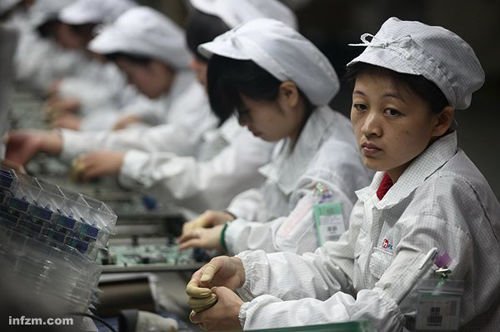 One of the biggest stories of the past week I’ve covered in the Asia technology space was the latest report from China Labor Watch into alleged rights abuses at Apple supplier Pegatron.
In terms of the abuses uncovered by the rights group, they’re pretty similar to those detailed at Foxconn over the years which led to a landmark agreement between Apple, the Fair Labor Association and the Taiwanese manufacturer to sort out conditions at its plants.
When I say “similar” I mean things like overworking and underpaying staff, breaking local employment laws through discriminatory hiring, excessive overtime and the like and subjecting employees to sub-standard living conditions.
You can usually gauge the seriousness of the allegations by the speed of the tech giant in question’s response and the length of its statement. So it was that Apple came back within a few hours with a long response claiming it had undertaken 15 audits at Pegatron and that it had been “in close contact” with CLW investigating findings highlighted by the group.
It added:
Their latest report contains claims that are new to us and we will investigate them immediately. Our audit teams will return to Pegatron, RiTeng and AVY for special inspections this week. If our audits find that workers have been underpaid or denied compensation for any time they’ve worked, we will require that Pegatron reimburse them in full.
One para that was lopped off my story referred to the fact that Pegatron facilities, including the ones mentioned in the report, produce gear for a raft of big name technology brands besides Apple. Microsoft, Dell, HP, Nokia and Asus have all had kit made by the Taiwanese headquartered manufacturer in the past.
Beyond Pegatron too there have reports of various rights abuses, in Samsung suppliers, and Chinese manufacturers making kit for firms including Telstra, Sony and Phillips.
However, the fruity-themed Cupertino giant, unfortunately for it, now has a reputation which makes it easier for hacks like me and rights groups like CLW to build a compelling narrative around such incidents.
For better or worse that’s the way it is but hopefully with Apple taking a lead, as it is certainly appears to be trying to do, on improving labour rights among its suppliers, others will follow. We mustn’t forget Apple boss Tim Cook used to be the firm’s COO and so will be well aware just how big a task it is to clean up the supply chain.
This is a process which will take years, not months, but it’s reassuring to an extent that stories like this still make the headlines, because once they stop then the whole process of improving the rights of shop workers in countries like China is likely to grind to a halt too.
Computex 2013: chips with everything
Posted: June 6, 2013 Filed under: Uncategorized | Tags: 2-in-1 device, acer, Asus, china, computex 2013, florentijn hofman, haswell, hong kong rubber duck, iconia W3, intel, IP, IP theft, microsoft, notebook, OEM, republic of china, silvermont, smartphone, tablet, taipei, Taiwan, transformer book trio, windows 8.1 Leave a comment So that was Computex Taipei 2013. Asia’s largest IT show and the world’s second biggest was dominated this year by the launch of Intel’s 4th generation Haswell processor family, and to be perfectly honest there wasn’t an awful lot of other news knocking around, but here’s my brief take on events.
Local heroes Asus and Acer kicked things off in usual hyperactive fashion with a bevy of tablets, notebooks, smartphones and other hybrid devices. The most notable was probably Asus’ 3-in-1 Transformer Book Trio, which combines a notebook, tablet and even desktop functionality in one.
Acer’s presser was more subdued and it remains to be seen whether it’s done enough to win back some of the market share it’s been hemorrhaging over the past few quarters. It actually also depends on whether users decide they want 2-in-1 notebook/tablets – as Intel believes they do – or a regular notebook with a smaller companion 7 or 8 inch tablet (phablet) device like the Acer Iconia W3.
How this market shakes out will be interesting to watch and to be perfectly honest no-one knows how it’s going to play out, least of all the many analysts I spoke to. It’s all about price, performance, and user experience – nail those three and as a manufacturer you’re giving yourself the best chance of success. Intel was marketing the hell out of the 2-in-1 concept at the show on the back of its Haswells and Silvermont Atoms, but I’m not convinced this will work out as intended.
It makes sense on paper – a tablet for tablet stuff and a notebook for work, in one hybrid device – but if you’re a fanboi, for example, you’re not going to want to give up your iPad, so a convertible isn’t going to cut it.
Form factor chat aside, Microsoft held its first public demo of Windows 8.1 at the show – the OS Windows 8 should have been. There are a lot of cool features in there – better search, the ability to view several apps on one screen and resize them, and the long awaited return of the Start icon. However, the experts are pretty guarded about whether it will be enough to a) rejuvenate the PC market and b) help Redmond grab more market share in the mobile computing space – tabs, phabs and notebooks.
“Being able to lock it in desktop mode and having a ‘Start Point’ will remove the chief barriers that people have with Windows 8. But that doesn’t necessarily address the things that are holding back the PC market as it is,” Forrester analyst David Johnson told me.
“Right now, at the consumer and enterprise level, non-Windows tablet adoption is massive, and Windows 8.1, while improving the tablet experience, will still be competing with Apple iOS and Android. Secondly, most enterprises are completely distracted by just getting to Windows 7 before the April 2014 deadline. They’re at capacity with that transformation and few will have the resources to worry about Windows 8.1.”
Taiwan was quite honestly the star of Computex this year.
I mean, it always has been, but the lack of news made it even more obvious. This is a country whose technology producers account for 80 per cent of the global “branded” tablet market and over 90 per cent of Intel notebooks. They might all be physically made in China but they’re designed here. The IP, basically, is Taiwanese.
It raises an interesting point about whether the People’s Republic of China can ever hope to emulate its tiny neighbour the Republic of China. The Communist Party desperately wants it to start innovating, but you can’t just turn on that tap at will after decades of stealing and copying IP.
Rubber ducks perfectly illustrate just how far it has yet to go.
Hong Kongers have been fawning over a new installation from Dutchman Florentijn Hofman for weeks now. It’s a giant, six storey, yellow rubber duck floating in Victoria harbour.
Now reports have emerged that similar ducks have been spotted across China, from Wuhan to Xi’an. They say imitation is the sincerest form of flattery, but in the tech world, it’s going to get China absolutely no-where.
MediaTek and the battle of the budget quad cores
Posted: December 21, 2012 Filed under: Uncategorized | Tags: 28nm chips, china, chips, huawei, LG, mediatek, mobile, MT6589, quad core, qualcomm, smartphones, SoC, Sony, Taiwan, US Leave a comment Last week Asian chip giant MediaTek launched its latest System on a Chip design, the 28nm quad core MT6589. Before you click on to something more interesting, here’s why it should make anyone with a mobile phone sit up and take notice.
First, MediaTek. It’s probably the most ubiquitous chip company you’ve never heard of. Asia’s biggest and the fourth largest fabless chip company by revenue globally, it lists LG, Huawei, Sony and others among its clients. Until now the firm has largely been focused on the 2G feature phone market, especially in China where demand was huge until recently, but this announcement sees it really break out into the high end smartphone space.
The analysts I spoke to pretty unanimously agreed that MediaTek and arch rival Qualcomm between them are making a seriously disruptive play in the mobile space. Put simply, MediaTek is making quad core affordable by sticking CPU, GPU and wireless modem on the same SoC, which means the MT6589 will end up in plenty of cheap smartphones as well as some higher end ones.
The result? The big brands are going to have to differentiate on something other than quad core. In effect, as IDC analyst Teck-Zhung Wong told me, it’s going to kick off a whole new round of price competition, which is great for users and will spur the industry forward to keep on innovating, which is good for all stakeholders.
In the background there’s also the tussle between Qualcomm and MediaTek.
Qualcomm is doing amazing things this year and now sits third by revenue in IHS iSuppli’s new ranking of global chip companies. It has already produced a quad core aimed at the same market and has an advantage in its modem capabilities, which even MediaTek admitted to me. So it’s Taiwan versus the US in the battle of the budget quad cores. MediaTek historically has that huge customer base in China to tap and is likely to be faster to market but Qualcomm is catching up and apeing many of MediaTek’s technical advantages and customer relations strategies.
The jury’s out but it will be an interesting 12 months to see who the smartphone winners and losers will be.
 phil muncaster