
Patriot games as hackers exchange fire over disputed islands
Posted: April 27, 2012 Filed under: Uncategorized | Tags: china, cyber crime, hacking, hacktivist, Panatag Shoal, philippines Leave a comment This week we saw more news emerge of the escalating tit-for-tat cyber attacks apparently being launched by actors sympathetic to the Philippines and China over a naval stand-off in the South China Sea.
Scarborough Shoal – also known as Panatag Shoal or Huangyan island – is the region long-disputed by the two countries and things got serious earlier this month after Filipino navy officials tried to arrest Chinese fisherman operating in the area but were stopped by Chinese surveillance boats.
Cue a barrage of cyber attacks on Philippine government and university web sites by apparent Chinese hackers, and then reprisals from the other side.
It’s pretty basic stuff, site defacement and DDoS attacks designed to send a clear message to the other side, and in this kind of thing China is probably a world leader.
Although it will never be revealed exactly how many patriotic hacktivists there are in the People’s Republic, what’s more interesting is their relationship with the government. In all but the most repressive states – think Iran or Syria – governments disassociate themselves from any hacking behaviour, but I learnt recently that China has done the opposite.
It has long been suspected, but China has effectively made a deal with the hacking community, a source told me, which goes thus:
- Never hack your own government or companies in your own country
- If you find anything of interest in your hacking activities which could help your country improve its status on the world stage, hand it over.
- When called upon to help the ‘cyber military’, make sure you respond
The deal is simple, the source explained, follow these rules and you can hack away with impunity. It means attacks of the sort seen this month on the Philippines can be carried out with the covert blessing of the government and the Party.
Of course the PRC’s standard response to these accusations is that it denounces all hacking activities, that it is taking steps to prevent cyber crime and that China itself is as much a victim of such attacks as western countries.
Even if tracking technologies mature to the level where the source of such attacks can be pinpointed, by operating at arm’s length, the government will always have the advantage of plausible deniability. It’s just a case of whether the international community will eventually lose patience with China and demand action, economic superpower or not.
Security experts speak their brains at InfoSecurity Summit Hong Kong
Posted: April 24, 2012 Filed under: Uncategorized Leave a comment One of the best things about being in Hong Kong at this time of year is, for the first time in about seven years, I’m missing the annual slog-fest that is the three day Infosecurity Europe show in London. While the speaker line-up in the keynote theatre is always of good quality (at least on the first two days), the constant cajoling from desperate PR professionals trying to set up last minute briefings with their clients is power-sappingly depressing at best.
However, I haven’t managed to shun IT security completely over here, thanks to the 4th MIG InfoSecurity Summit at Wan Chai’s Hong Kong Convention and Exhibition Centre (HKCEC). Eschewing the vendor pitches, as always, I snuck into the panel debates to find some refreshingly honest discussions from the assembled IT experts.
The first was all nominally about disruptive tech, but some of the most interesting comments came about plain old threats. SH Lim, head of infosecurity at Hong Kong Jockey Club hit the nail on the head when he said the future entailed “a lot of us losing our hair”. Humour turned to exasperation soon after when discussing the problems of dealing with zero day threats and tardy patches.
“How fast can any organisation patch versus how fast can the malware writers write malware,” he added. “How do we test our apps within five days? Do we do a self-DOS by causing an app to fail by not testing a patch properly?”
SC Leung, senior consultant at the HKCERT, went further, blaming cloud computing.
“Cloud computing is great technology but the criminals are using it more efficiently for web hosting and they can subscribe to cloud services to get bandwidth on demand,” he said.
“They can hack computers thanks to the computing power of Amazon and it’s very hard to trace them. We need to solve this problem with the cloud service providers.”
Fair enough. But blaming cloud computing for security threats is like blaming ammunition manufacturers for war. The causes need addressing more holistically to make a difference.
The second panel debate focussed much more on the changing role of the CISO. Nothing ground-breakingly new there but again some good advice for budding security chiefs, namely, brush up on your business skills and learn about risk management rather than get bogged down in tactical, technology-focussed issues.
There was also a word of warning that CISOs everywhere need to heed – beware the regulator.
Chinese government urges local mobile firms to build own platforms
Posted: April 17, 2012 Filed under: Uncategorized Leave a comment This is a strange one. A report issued by part of China’s Ministry of Industry and IT (MIIT) has apparently warned the country’s home grown mobile phone makers to beware of getting sued by foreign firms looking to assert their patents.
The report is long and in Chinese, so I’ve had to take China Daily’s word for the content of the paper – never the best and most reliable source of the truth, but given the report is government led, the state-run paper is unlikely at least to have hidden any important facts.
The message is fairly clear – now that China produces most of the world’s mobile devices and now its domestic brands have edged out international competition in the People’s Republic, patent holders from abroad may start sniffing around.
All of which is fair enough. China is a dominant player in the global mobile market, but why was the report written now, and what are the alternatives?
Well, as IDC’s Melissa Chau told me, there aren’t really any. Even the supposedly home grown operating systems mentioned in the report from various Chinese operators, Baidu and Alibaba, are based on forks of Android. These have singularly failed to capture the popular imagination, she said.
If the government is suggesting, as appears to be the case, that mobile makers look for alternatives to Android – the OS which is currently battling Oracle over Java patents and Microsoft – then it is going to take some time.
I’ve no doubt that China’s domestic brands will get there in the end. In fact, Deloitte’s William Chou said as much when I chatted to him a month or two ago.
“No Chinese handset maker has a solid platform that can compete with Apple and Google yet but we are at a very early stage,” he said at the time. “Vendors like Huawei and Lenovo are providing smartphones not because they want to earn a profit from the sales but because they eventually want to dominate the application market.”
India could be Japan’s tech saviour as demand rockets
Posted: April 12, 2012 Filed under: Uncategorized Leave a comment In my brief to cover the science and technology space in Asia for The Reg – yeah, pretty busy at the moment, thanks for asking – India is fast becoming a fertile source for stories.
It can be spoken of in the same breath as China in many ways in that they are both burgeoning nations with huge populations, a growing middle class and aspirations to lead the world in their own ways in the production and consumption of technology.
So it was no surprise when I read Gartner’s latest stats indicating Indian consumption of semiconductors is set to grow faster than any country this year – up by 20 per cent from 2011 to reach a whopping $9.2bn in revenue.
Compared to a global average of just four per cent growth it’s clear the country is undergoing a rapid transition.
Gartner research director Ganesh Ramamoorthy told me that the growth is likely to be sustained for some time to come, driven by huge demand for mobile phones, PCs and LCD TVs in the country.
Due to the low penetration of such kit in India at the moment, the potential is there for CAGR of 16 per cent to 2016, he added.
All of which is good news for Asian companies in general, because while India may be consuming all those semiconductors, it doesn’t make them.
“I do see China based semiconductor companies benefiting a lot because a substantial amount of semiconductor requirements of local manufacturers in India is imported from China,” said Ramamoorthy.
“The strong, growing demand for overall electronic equipment in India benefits other companies as well such as LG, Samsung, Panasonic, Toshiba etc, from countries like Korea and Japan.”
Japanese tech firms in particular have had a tough time of it of late and are struggling in the shadow of China. Salvation comes from strange places sometimes.
Jury’s out on Apple and Foxconn deal with FLA
Posted: March 30, 2012 Filed under: Uncategorized | Tags: apple, china, fla, foxconn, ipad, iphone, wage Leave a comment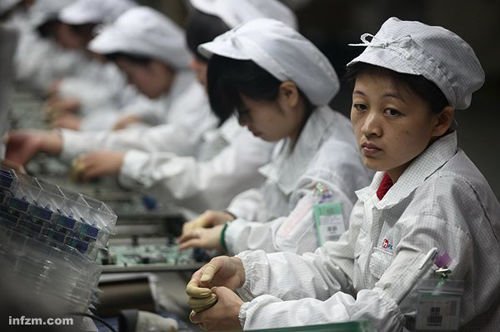
(source: infzm.com)
Have just finished a news story for The Register on what Reuters is calling a ‘landmark deal’ between Foxconn, Apple and the non-proft Fair Labor Association over pay and working conditions at Foxconn plants.
Now we can all talk ad nauseum about whether Apple is being unfairly singled out here and whether the workers even want or deserve to be treated differently than the vast majority making our clothes, shoes and shiny toys.
But here are the facts.
People committed suicide at these factories, quite a lot in fact, and I don’t buy the fact they were all depressed country bumpkins out of their depth in a new environment – there must be something seriously wrong inside those plants to lead to that.
So a couple of points to note from this. I was quite impressed the FLA produced such a damning report of conditions – many groups expected them to either go easy on App-conn or for the factory owners to have improved conditions to such a degree for their planned inspection that they got a rose tinted view.
This didn’t happen.
So as a result of the guarantees Foxconn and Apple have given, overtime and working hours will come down to within legal limits, accidents will be more accurately recorded, internships adapted, and union elections will not be interfered with by management.
All of which is great, but I’m going to remain sceptical until July 2013, when the deadline for changes comes (why so far away, by the way?!).
For one, the report doesn’t mention the management abuses of staff – either mental or physical – which some argue contributed to those suicides, and the it also glosses over the widespread abuses of the internship scheme as uncovered by SACOM.
There are other guarantees given by Foxconn which will be very hard to substantiate – whether union representatives are elected freely, accidents are recorded properly and overtime compensation doled out appropriately, to name but a few examples.
The proof for this will certainly be in the pudding, and as I’ve said before, the key to it all is consumer pressure – that drifts away and things could very easily slip back into old patterns.
Scalpers on standby at the Hong Kong Apple Store
Posted: March 15, 2012 Filed under: Uncategorized | Tags: apple, hong kong, ifc mall, ipad 3, scalper, store Leave a comment They just don’t get it do they?
Every time a shiny new Apple toy comes out in Hong Kong, so, it seems, do the mainland scalpers. I popped down there on Wednesday evening ahead of the new iPad launch on Friday to see what all the fuss was about and sure enough, there was a gaggle of rather dishevelled looking souls camped outside.
As I wrote in this story for The Register, though, they didn’t look like your typical scalpers. I’m not being sexist here but i had more to mind large, burly male types rather than young women and old men. They were also camped rather a long way from the Apple store – over a footbridge and down some steps to be precise, but that could be as it’s the closest to the IFC Mall that the police will let them stand.
A pretty pissed off police officer told me they’ve been asked to move on several times but won’t budge – some one has even stuck up signs in English and Chinese saying Apple will not allow first come first served walk-in purchases on Friday, but to no avail.
In fact, the policeman got even more exasperated as, when I was talking to him, he noticed an Apple store official demonstrating one of the new iPads to the assembled crowd. If they are scalpers, it’s a pretty strange way to treat them.
In the end it’s all down to supply and demand. It doesn’t matter that Apple has instigated a strict Reserve and Collect system which requires pre-registration and authorisation via the web site before users are given the chance to collect in store the following day.
If there are no new iPads on sale in China and no slated release date, as there isn’t at the moment, then some chancers are always going to come over the border in a bid to buy some in order to sell on at vastly inflated prices.
We’ll have to see what happens on Friday, but I’m pretty sure there’ll be some shady bargaining going on with successful iPad 3 customers as they leave the store with their shiny new toy.
What is going to happen in the Apple Proview iPad case
Posted: March 2, 2012 Filed under: Uncategorized | Tags: apple, ipad 3, legal, proview, trademark 1 Comment Another week has gone by and still the Apple Proview iPad trademark conflict has yet to be resolved. I’ve covered this one pretty extensively for The Register now so here’ my two pence worth.
So the state of play at the moment is that Guangdong High Court has adjourned to consider Apple’s appeal against an earlier judgement in Shenzhen which ruled in favour of Proview, effectively preventing Cupertino from selling iPads in China.
When it comes down to it the disagreement is pretty simple. Apple reckons that I bought the trademark for several regions including China fair and square from Proview. However, the bankrupt monitor company claims it didn’t buy the trademark for use in China as it didn’t deal with Proview Shenzhen, the affiliate which held that particular TM.
In the appeal court, which didn’t really see any new evidence or arguments presented by the way, Apple complained that Proview misled it and that it signed documents saying it has the rights. Proview said that even if it did, its Taiwanese entity is separate from its Shenzhen company and therefore did not have the right to sell.
So here’s what’s going to happen.
I’m pretty sure Apple will have to settle out of court on this one. The market in China is worth billions. In fact, Apple is already making billions of pounds in smartphone and tablet sales – where some figures put it as market leader.
The company is also hugely profitable, so even a $2bn pay out, as some are saying Proview is asking for, would be do-able, although the only worry here is that the precedent will be set for other Chinese companies will try to hold Apple to ransom down the line.
In all honesty though, it’s a drop in the ocean for the company and with the iPad 3 coming out as soon as next week according to reports, Apple would be crazy not to get this resolved – it has a already seen the Chinese are very quick at enforcing a sales ban if the judgement went against it.
The options some have mooted of changing the iPad’s name in China, in local language at least, or of building a differently designed machine for that market, are just not going to happen.
Watch this space.
The battle to save Apple’s soul
Posted: February 29, 2012 Filed under: Uncategorized Leave a comment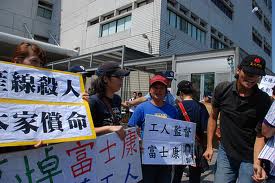 Have just had time to take stock of all the crazy goings on with Apple and Foxconn last week and I think this story will run and run, much to Apple’s frustration, for a while to come yet.
I managed to track down Debby Chan, a project worker at non-profit organisation Students and Scholars Against Corporate Misbehaviour (SACOM) for a fascinating chat which generated some pretty dynamite pieces of information.
Bear in mind the following are all allegations, some from chats Debby has had with Foxconn staff, so it’s best to remain sceptical, but still:
- Local governments ‘repay’ Foxconn for choosing to locate factories in their area by helping to man them with vocational students. Apparently it doesn’t matter what the vocation is, they get shipped off anyway for a few months or more of misery which could mean them failing to graduate or having to drop out. This is basically forced labour.
- High profile they may have been but the FLA inspections of Foxconn’s factories are flawed because the company has prepared for them by giving workers more breaks, and by hiding the underage workers away – so they pass inspection.
- The FLA itself could be accused of favouring the interests of the big name companies like Apple which are members and sit on its board, making a mockery of these ‘independent’ inspections.
Now Foxconn has strenuously denied the allegations of underage workers and wages have been put up, while Apple CEO Tim Cook has made noises about micro-managing timesheets to make sure workers aren’t put under too much pressure.
But how much of this is just spin? Some people have suggested that this is Apple’s Nike moment and it’s important to remember that ultimately all a company wants to do is make money – sell products, maximise its profits and dominate the market. It’s capitalism, and it’s never been particularly pretty.
The only way of stopping these companies from doing what they want no matter how horrendous the human cost, is by helping their affluent, mostly white, middle class, western customers realise what’s going on.
So well done to Debby and the people at SACOM and their various partners for trying to bring these issues to light. It seems to be working, as witnessed by the inspections themselves, although as Chan explained to me, the time for inspections is over. There needs to be proper union representation in the factories and a way of monitoring conditions on an ongoing basis.
I think the arguments saying Foxconn is a relatively good payer in China and that some of the suicides at its plant could be blamed on the mental health of rural workers not being able to cope with such hard and monotonous work is missing the point.
I don’t know many people who’d rather not spend a little more on their shiny new iPhone/Pad/Pod etc if they could be assured it was manufactured in decent conditions by workers who receive a decent wage and are treated with respect.
The only worry is that the ever fickle customer will eventually get distracted and move onto some other piece of news long before the problems have been properly addressed, while Apple’s spin machine works overtime to claim enough improvements have been made.
Can Baidu make it big on the world stage?
Posted: February 20, 2012 Filed under: Uncategorized Leave a comment Chinese search engine Baidu had a busy week last week, launching a new version of its browser software, announcing decent financials and planed expansion internationally and into the mobile space.
As I wrote in The Register, however, it’s unsure whether the company which has roundly trounced Google in its home market has the ability to do the same to the US web behemoth across the Pacific.
Reports emerged that the firm is planning to set up some kind of outpost in Brazil – dangerously close to Googleland – while CEO Robin Li said it would be looking to build on its strong financial performance in 2011 by monetising mobile traffic and social media platforms and expand internationally.
The mobile piece makes absolute sense. With the mobile internet expected to far outgrow its fixed line antecedent – especially in developing countries – it’s an area any web company should be concentrating on.
Gartner analyst Roger Sheng told me that the firm would look increasingly to hardware partnerships with the likes of Lenovo, ZTE and others to gain a bigger foothold in the mobile space and to make money out of this market, while also looking to monetise its mobile search traffic.
The international picture is a little less clear, however. Baidu has traditionally failed to set the world alight outside China. Despite launching various services in Japan, Thailand and even the Middle East, the firm has struggled to differentiate its offerings from local competitors.
According to SEC figures cited in a recent China Daily report, the firm actually lost over $100m from its international operations between 2008 and 2010.
Put simply, it is still an immature company on the world stage and will be roundly beaten in Brazil, where Google has a virtual monopoly, just as it was in Japan. Those tasked with masterminding a reversal of these fortunes from the firm’s new offices currently being built in Shenzhen will certainly have their work cut out.
Baidu made great play of being the home grown champion when Google was falling out of love with China, and may have won users over by ramping up the nationalism. It is also thought to have been simply better at dealing with Chinese language queries.
Both strategies are doomed internationally. It’s going to have to come up with something a little different to conquer markets outside the People’s Republic.
Facebook and China: a marriage definitely not made in heaven
Posted: February 9, 2012 Filed under: Uncategorized Leave a comment So, much of the talk this week has been whether Facebook’s latent desire to crack the Chinese market is actually going to lead anywhere. I wrote a piece for The Register based around some excerpts from the social networking giant’s IPO which indicate it is definitely still keen.
The next question to ask, then, is whether this is a good idea for Zuckerberg and co. I mean, he may be trying to learn Mandarin but that’s not going to count for much in the hard nosed business world in which Facebook now operates.
Firstly, it’s obvious that any Facebook – China detente is likely going to have to involve the former making some pretty big concessions over censorship and restricting certain content. That may give it the keys to the Chinese kingdom but it’s certainly not going to win it any friends internationally.
The repercussions of Twitter’s recent decision to allow tweets to be removed at a country level are still to be felt but the firm may be in danger of undoing all the good work its service has managed in the Middle East and beyond giving voice to the oppressed and ignored. Facebook could very easily follow in its path.
Secondly, as I mentioned in my news story, the firm will have some fierce competition from some quite mature and very popular home grown social networking rivals such as Sina, Tencent and Renren.
Finally, and maybe more importantly for Zuck and co, was the point made in a Reuters report that online advertising is still not a very big deal in China. As I’m sure the social networking behemoth is aware, the Chinese market is not the cash cow many are making it out to be.
 phil muncaster